
FORUM IP PLUS
FORUM LITE PLUS
Digital audio mixers with IP connectivity
Three-band parametric equalisers, filters and dynamics
Up to 32 mix buses for program, auxiliary, monitor and clean feed outputs
Optional remote control and operation support tools
Digital Audio Mixers for Radio and TV
FORUM PLUS is a family of digital audio mixing consoles for Radio and Television, specially designed for ON-AIR broadcast control and adaptable to different work flows. Simplicity and control power are combined in FORUM IP PLUS and FORUM LITE PLUS to cover both basic and advanced operation needs. Available in two formats: recessed and desktop.
FORUM IP PLUS
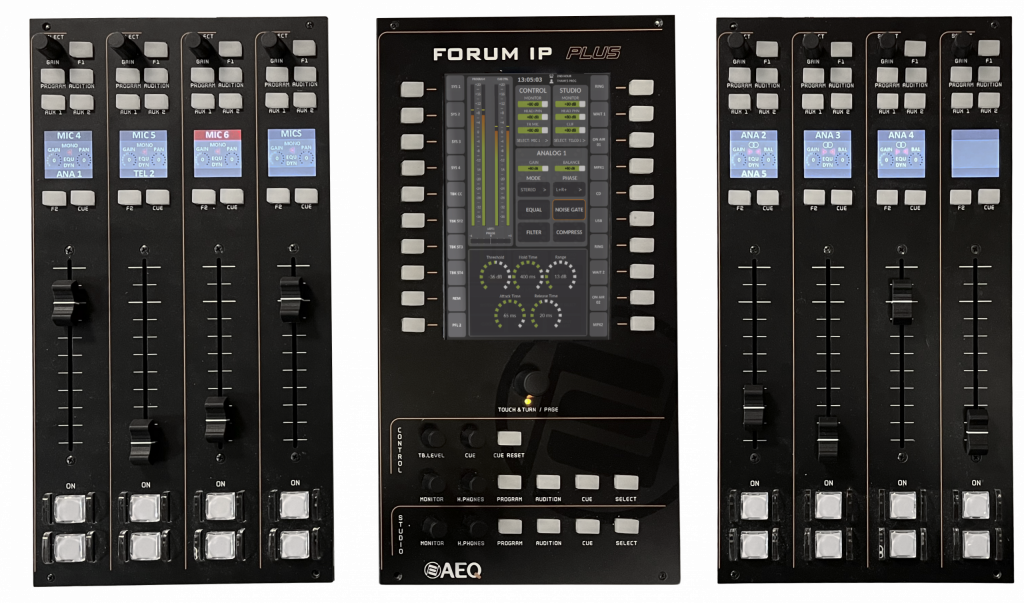
Modular console in motor and surface, with motorized faders and programmable keys per channel. Up to 24 faders and more than 180 channels.
FORUM LITE PLUS
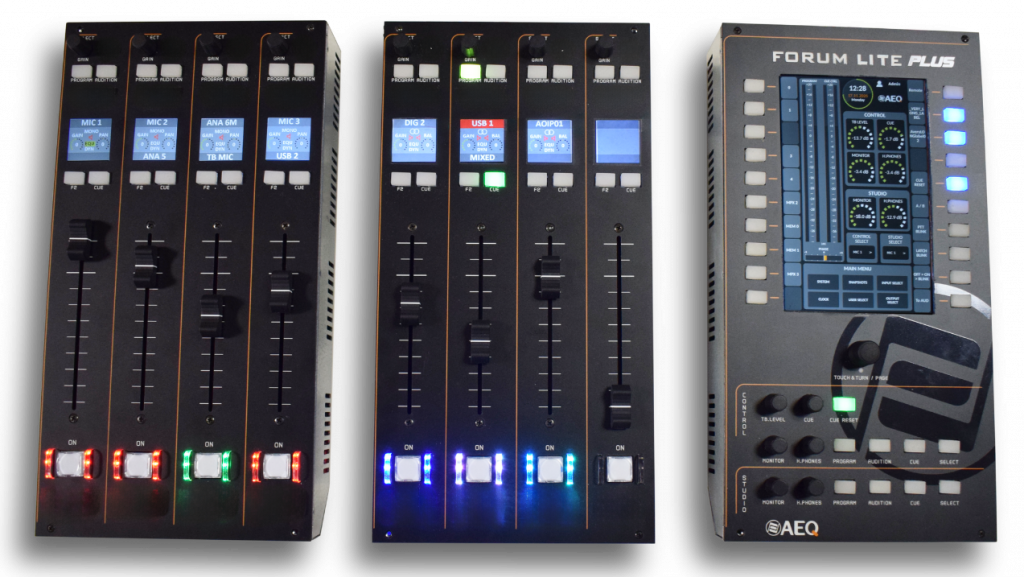
Console with modular surface and compact motor, with 5 programmable keys per channel, 12 faders, and more than 92 channels.
Functional
description
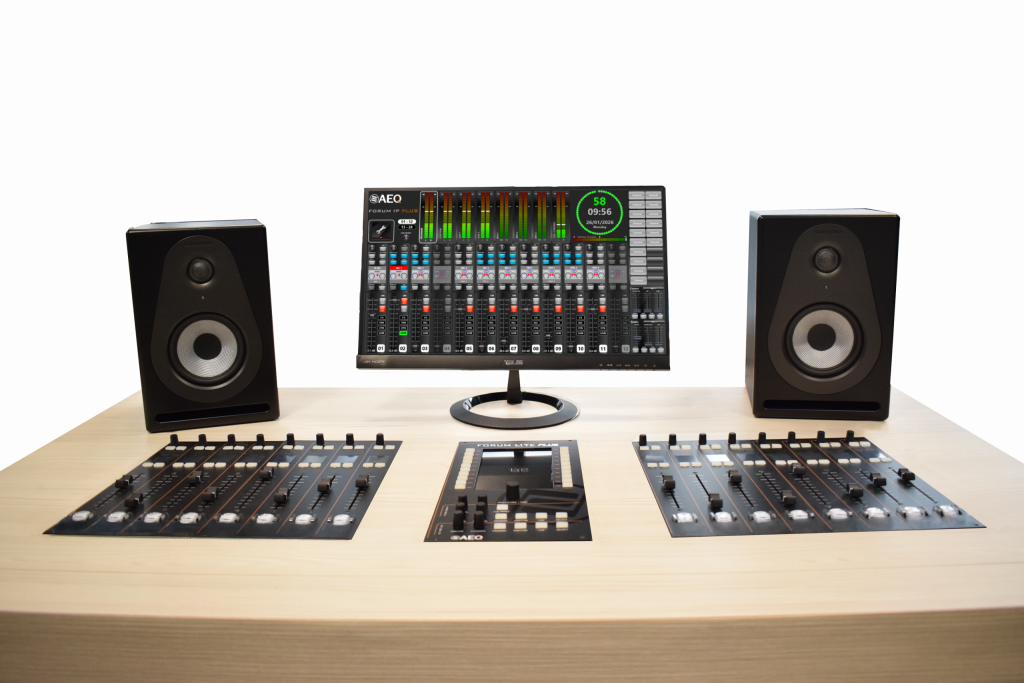
AEQ FORUM PLUS control surface is built on independent 4-fader modules, from a basic 4-channel configuration, through 8, up to a maximum of 24 channels in the IP PLUS version, and up to 12 in LITE PLUS.
The assignment of signals to channels in AEQ FORUM PLUS is fully user-definable: it is possible to assign signals present in the system to channels, so that the same channel can control one signal at one moment and a different signal at another moment. This makes it possible to reorganize the distribution of channels to suit different programs or operators. Multiple signals can also be handled on a group fader.
Lite PLUS Version
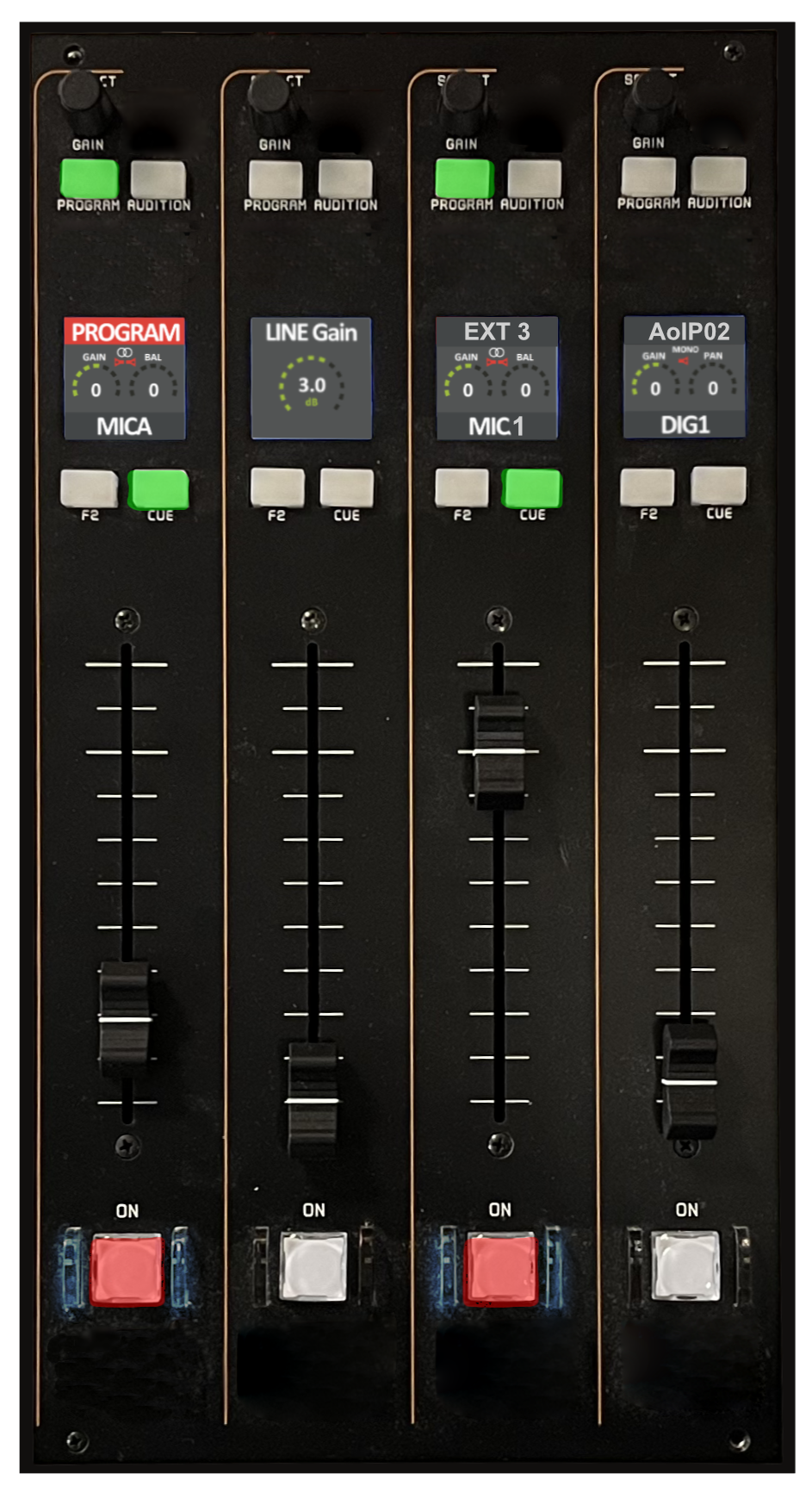
“Gain” button and “select” push button
2 routing buttons
Channel display:
shows A/B names and channel status
Free programmable buttons
CUE button
100mm fader
Channel activation button
Each channel has an encoder for adjusting gain and other functions.
The four programmable keys at the top of the channel are pre-assigned to the PROGRAM, AUDITION, and CUE buses, while F2 is reserved for special uses.
The display shows the name and status of the main channel and an alternative channel B.
IP PLUS Version
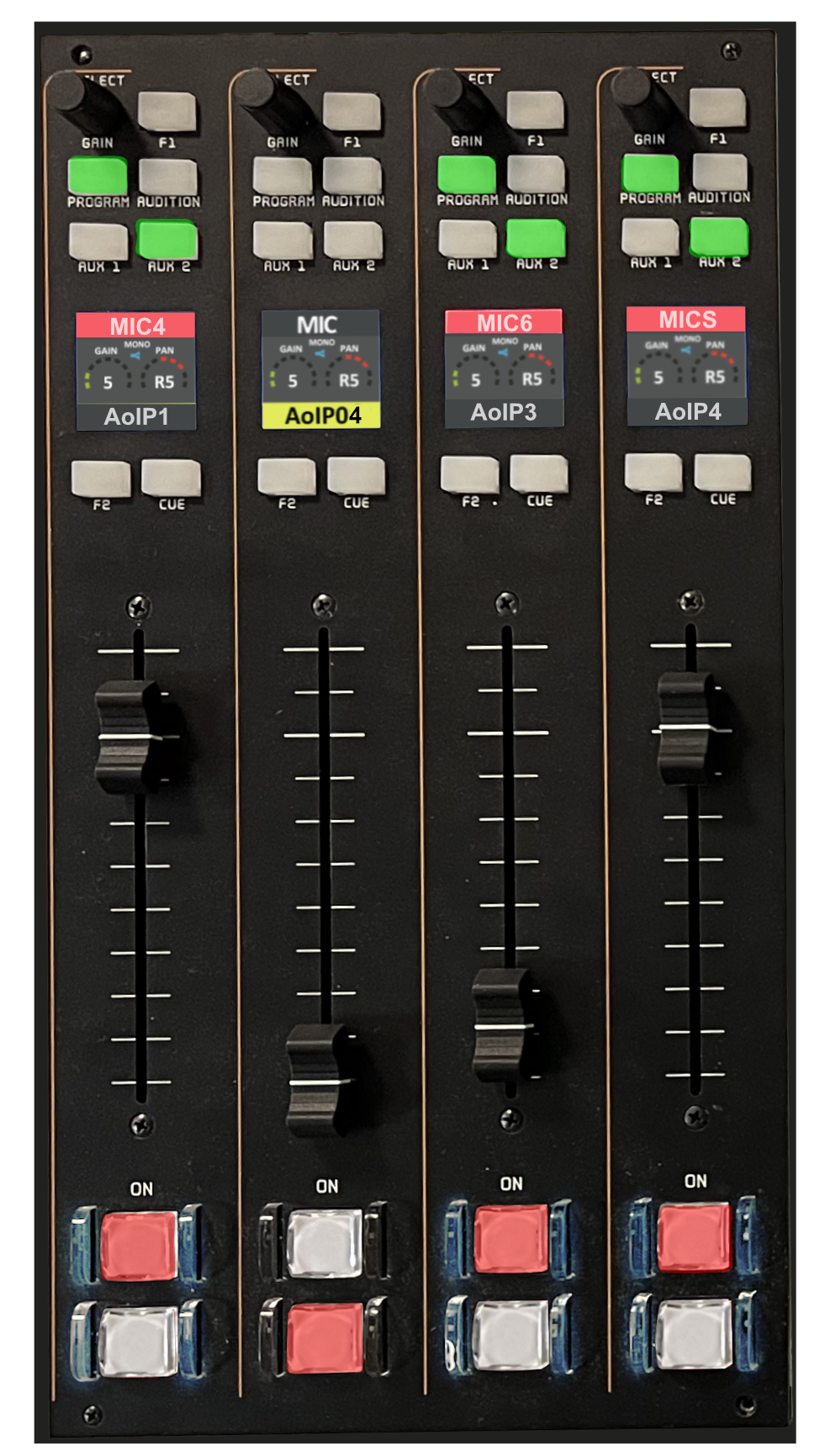
“Gain” button and “select” push button
4 routing buttons
Channel display:
shows A/B names and channel status
Two freely programmable buttons
Two freely programmable buttons
Two freely programmable buttons
CUE button
100mm motorized fader
Channel activation button
The seven programmable keys at the top of the channel are pre-assigned to the PROGRAM, AUDITION, AUX1, and AUX2 buses, while F1 and F2 are reserved for special uses.
The programmable key at the end of each channel, set to OFF by default, allows for alternative special operating modes such as channel A/B and talkback to the other party on bidirectional channels.
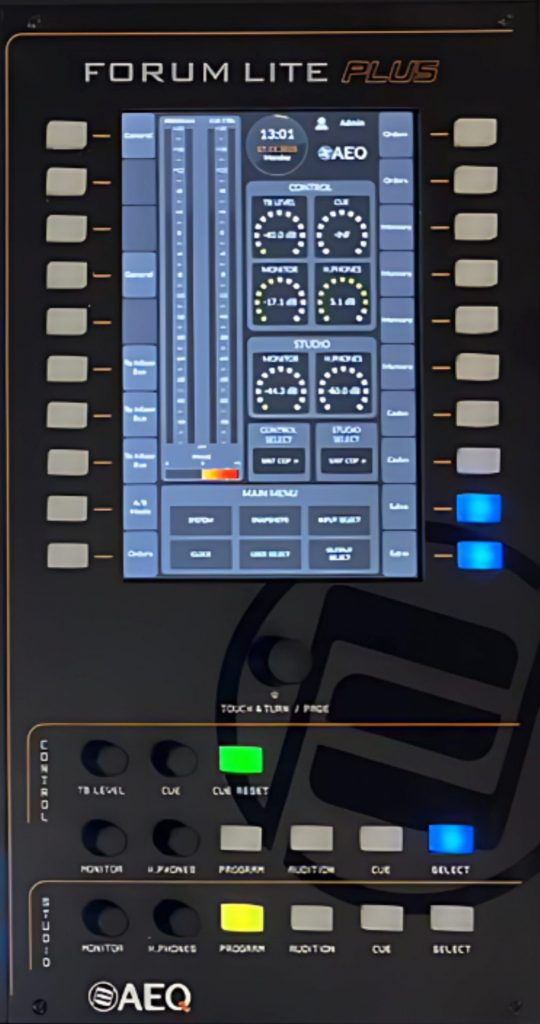
Touchscreen for control and configuration
Programmable keys with on-screen labels
Fine adjustment encoder, page button
Control monitoring
Study monitoring
At the bottom of the module are the control and studio monitoring areas and basic talkback keys. FORUM IP PLUS has two sections for independent monitoring of the control room and the studio or booth.
At the top of the module there is a touchscreen and 20 programmable keys with on-screen labels. The screen always displays two high-precision stereo digital VU meters that can be assigned to the PROGRAM outputs or, using the CUE keys, to any selected signal.
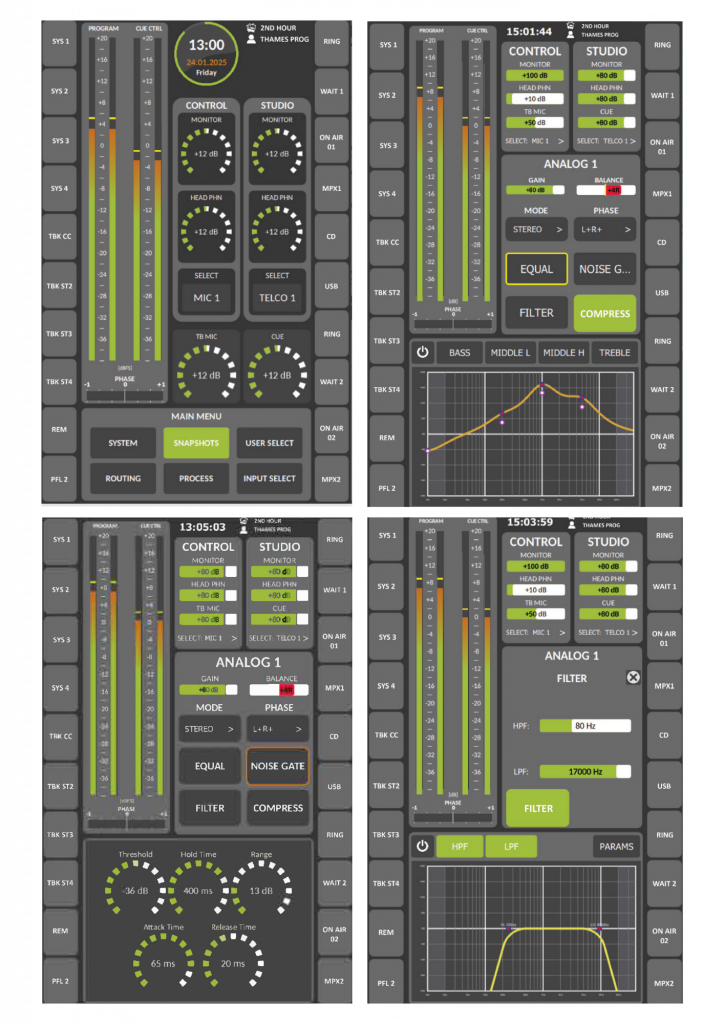
The screen displays controls and images for advanced settings. Pressing the encoder for each fader channel selects the channel to access the advanced settings functions. These settings can also be configured in the Virtual Forum application. Operation is based on keys and contextual menus, depending on the information displayed on the screen. The touch & turn button facilitates precise adjustment of parameters.
Audio Engine and Connectivity
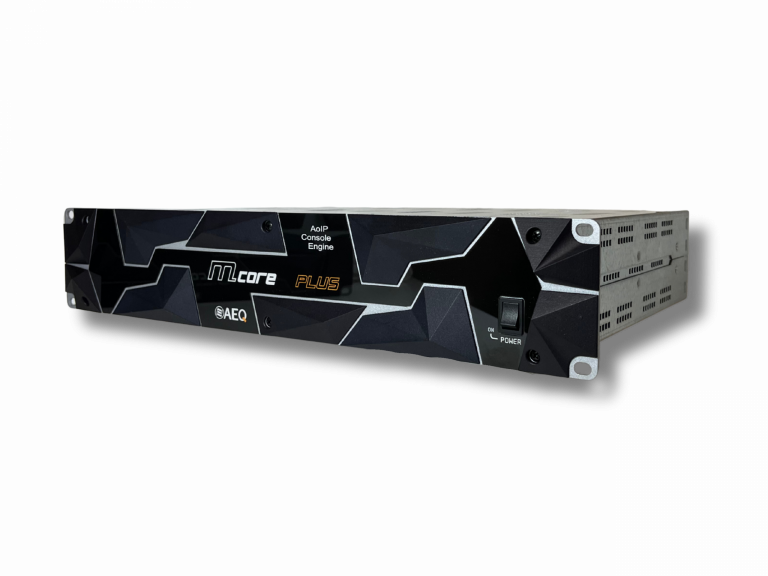
FORUM IP PLUS comes with the FR CORE PLUS modular engine, consisting of 3 rack units with 14 slots for inserting input and output modules into its rear panel. The LITE PLUS version comes with the compact M_CORE PLUS engine, consisting of 2 rack units with fixed connections.
Both can be equipped with redundant power supplies and licenses for operation assistance and remote control applications.
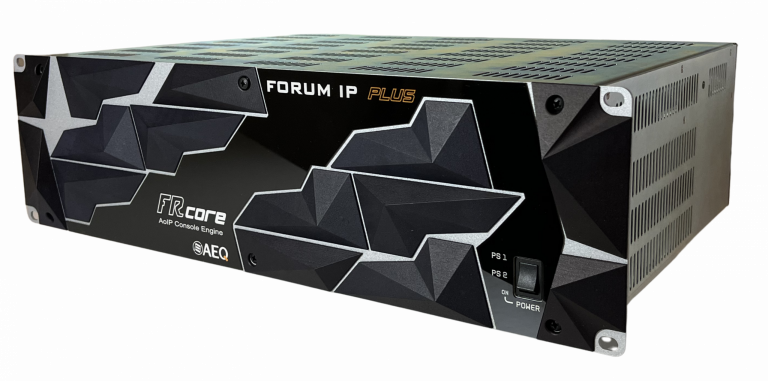
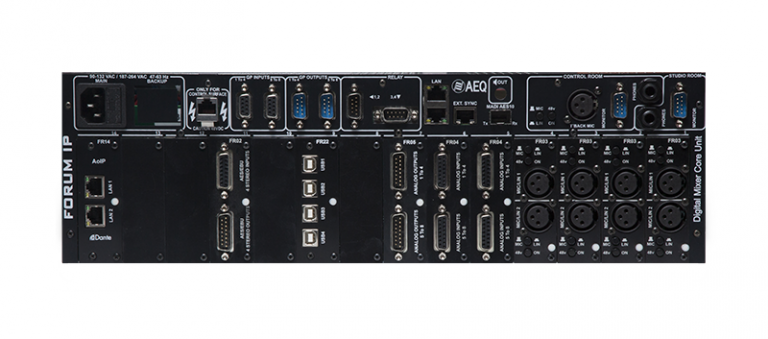
3-unit chassis with 14 slots for inserting input and output modules into its rear panel. It also incorporates general-purpose inputs and outputs such as self-monitoring and talkback microphone, control monitor, studio monitor, CUE, control and studio headphones, and GPIOs. The console’s I/O capabilities can be expanded via NETBOX AEQ modules, increasing the number of mono analog inputs and outputs (or stereo pairs), stereo digital inputs and outputs, mic/line inputs, stereo headphone outputs, and GPIOs.
Supports a maximum of 14 multiple input and output modules, 4 of which can be dual micro-line, two digital hybrid, and two AoIP.
Integrated additional micro-line input for talkback and self-monitoring.
Multichannel: IP via 1 FR14 module with 32 audio channels per IP using AES 67 technology in DANTE format. A second module can be added as an option. Alternatively, MADI via optional internal 64 I/O module.
FR02: DIGITAL INPUT/OUTPUT MODULE:
– 4 AES/EBU digital stereo inputs.
– 4 AES/EBU digital stereo outputs.
– SRC on all inputs.
– Supports AES-EBU or SPDIF formats.
FR03: MICRO/LINE INPUT MODULE:
– 2 switchable MICRO/LINE inputs.
– Independent 48V PHANTOM ON/OFF switch per input.
FR04: ANALOG LINE INPUT MODULE:
– 8 electronically balanced mono line-level inputs.
FR05: ANALOG LINE OUTPUT MODULE:
– 8 electronically balanced mono line-level outputs.
FR11: AES 10 MADI SYNCHRONOUS MULTICHANNEL MODULE:
Up to 64 audio channels in each direction to interconnect the console with a router or another console located hundreds of meters away using a simple pair of optical fibers. Does not occupy input or output slots.
FR14: AES67 / DANTE™ AoIP MULTICHANNEL MODULE:
Adds 32 AoIP channels from the network to the console and makes 32 audio channels from the console available to any device on the network. Two RJ45 connectors (redundant or daisy chain operation). One comes standard with the console.
FR22: USB INPUT/OUTPUT MODULE:
– 4 USB digital stereo inputs/outputs.
– SRC on all inputs.
– Implements standard “USB audio device” devices in the PC operating system.
FR33: DIGITAL TELEPHONE HYBRID MODULE:
With connector for telephone line and auxiliary telephone terminal.
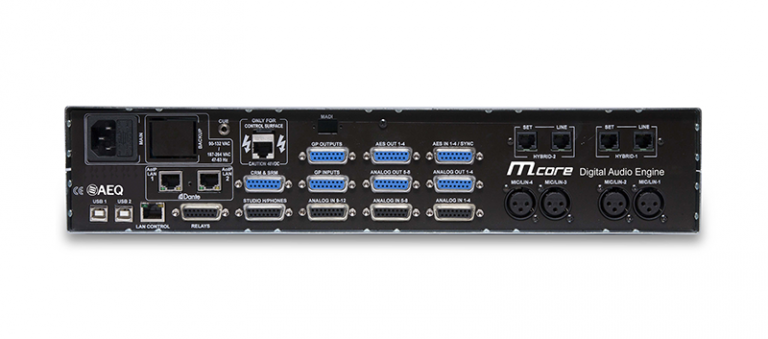
2-unit chassis with a fixed configuration to which some optional cards can be added. It incorporates general-purpose inputs and outputs: control monitor, studio monitor, CUE, control and studio headphones, and GPIOs. It also includes a 16-channel AoIP card.
Inputs
– 4 mono mic/line inputs, switchable from the front panel. Phantom power configurable from the front panel.
– 2 USB stereo digital inputs (I/O).
– 4 AES/EBU stereo digital inputs configurable as SPDIF.
– 12 analog inputs (individually configurable in stereo pairs, 6 pairs).
– 16 AoIP inputs. Bidirectional module that incorporates 16 channels of AoIP from the network into the engine, 4 of which are preconfigured to receive from the control surface. Two RJ45 connectors (redundant operation or Daisy Chain).
Outputs
– 2 USB stereo digital outputs (I/O).
– 4 AES/EBU stereo digital outputs configurable as SPDIF.
– 8 analog outputs (individually configurable in ST pairs, 4 pairs).
– 16 AoIP outputs. Bidirectional module that delivers 16 AoIP channels from the engine to the network, 4 of which are preconfigured for the control surface. Two RJ45 connectors (redundant operation or Daisy Chain).
MCORE MADI: AES10 / MADI MODULE:
Up to 64 audio channels in each direction to interconnect the console with a router or another console located hundreds of meters away using a simple pair of fiber optic cables.
MCORE DANTE 32: AES67 / DANTE™ MULTICHANNEL AoIP MODULE:
Replaces the default 16-channel module. Adds 32 AoIP channels from the network to the console and makes 32 audio channels from the console available to any device on the network. Two RJ45 connectors (redundant operation or daisy chain).
MCORE HYB: DUAL DIGITAL TELEPHONE HYBRID MODULE:
With connectors for telephone lines and auxiliary telephone terminals.
Visualization and Control Software
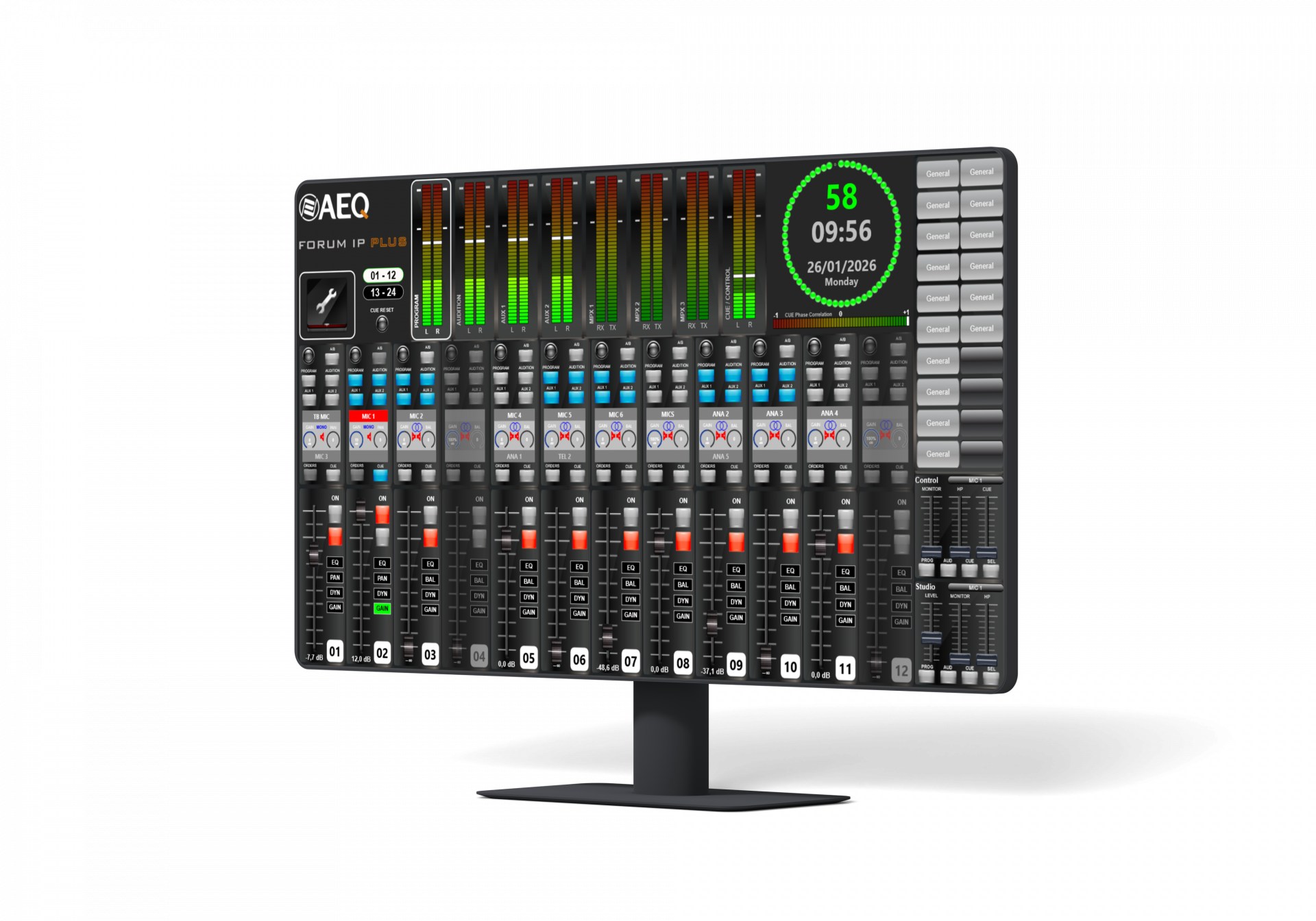
Virtual Forum
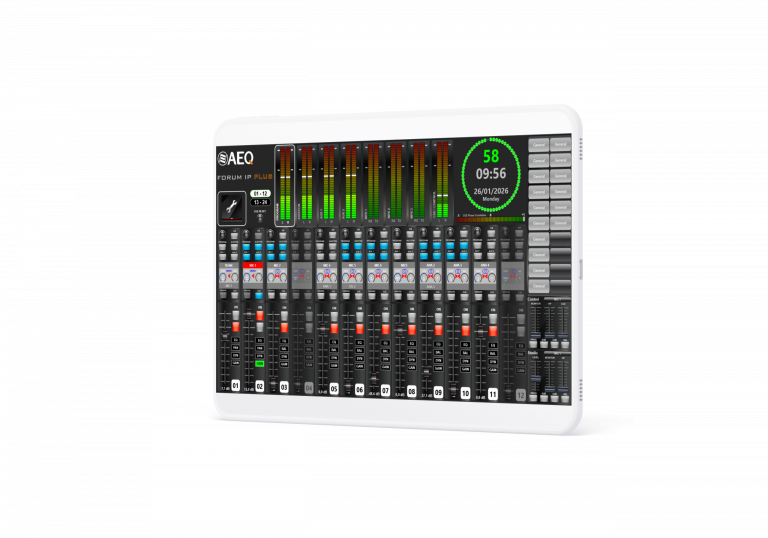
This application works as a complement to the FORUM IP digital console, displaying an exact representation of the console’s control surface on a Windows or iOS device, whether a PC or tablet, allowing it to be controlled in parallel or alternatively to the surface, thus enabling dual or remote management.
It also incorporates 6 stereo VU meters, a phase meter and a large-size replica of the console clock, to facilitate more convenient use of the console when it is present.
Mixing on your PC or Tablet
Technical Features
Cough cut, ON-AIR signaling for studio and control.
Fader-start, remote PFL, talkback, automatic monitor cut.
N-1 output configuration.
External equipment control (hybrids and AEQ audio codecs) integrated into the programmable key section.
Independent Pre Fader / Post Fader option for all routings.
Control communication via 10/100 Ethernet connection under TCP/IP protocol.
Auto-start (selectable) with last settings (or default settings).
Signals assignable to any control channel.
Memory storage of all signal settings: one basic configuration and 6 user-defined configurations.
- Optional console display and control software.
Connectivity
- Integrated monitor and headphone outputs for control room and studio.
- Stereo CUE output on engine. Mono CUE output on control surface.
- Phantom power and electronic balancing for microphone inputs.
- Electronically balanced analog line inputs and outputs.
- Transformer-balanced digital inputs and outputs.
- Sample rate converters (SRC) for all digital inputs.
- Compatible with AES/EBU, S-PDIF, and USB digital signal formats.
- Supports 64-channel AES 10 MADI digital audio connection via fiber optic.
- IP connection via multi-channel AoIP links using DANTE™/AES67 protocols.
- Incorporates IP link with surface that adds a microphone, bidirectional Bluetooth, mono CUE, and headphones.
- 8 opto-coupled GPIs and 8 GPOs and 4 GPOs via relay contact.
- Hot-swappable modules for easy maintenance.
- Supports up to 14 multiple input and output modules, 4 of which can be dual micro-line, two digital hybrids, and two AoIP. Comes equipped with one AoIP module as standard.
- Additional integrated switchable mic/line input for talk-back and self-monitoring operations. (There is another input on the surface for this function).
- Optional multi-channel connectivity: Second 32-channel AoIP module with DANTE/AES67 protocol.
- Alternatively, MADI via an internal 64-channel I/O SFP fiber transceiver module.
- Width: 482.6 mm (19″).
- Height: max. 3 rack units, 135 mm (5 3/8″).
- Depth: 310 mm (12 ¼”).
• Optional Internal dual digital telephone hybrid with two connectors for line and two for SET.
• Multi-channel connectivity expansion option: Replacement of the internal 16-channel module with DANTE/AES67 protocol with a 32-channel module.
• Alternatively, MADI via an internal 64-channel I/O SFP fiber transceiver module, incompatible with AoIP.
- Width 482 mm (19″).
- Height 2 u rack. 89 mm (3 ½”).
- Depth 330 mm (13″).